Team Measures in Baseball
I spent the weekend looking at baseball through the lens of “measuring team performance”. There are a lot of individual measures in baseball to tell a player how well he is doing. Team measures, other than Wins/Loses are a lot harder to come by.
So, I am looking for some measures that look into the heart of a team. Does the team play hard and have the guts, courage and tenacity to compete. Nothing new here, but these are the measures that come closest for me (and pretty much directly relate to wins/loses, but are a lot more controllable to players):
Win 3 innings =>measures tenacity and persistence. John Wooden uses the term “intentness” for this. In a 7 inning game, if you win 3 innings, you will win 90+% of the time. If you don’t win the 3rd inning, it is up to luck.
But, inside of the “Win 3 innings story there are several subplots:
Prevent/Achieve a BIG Inning => string a series of Quality At Bats together to score 3 or more runs in an inning. From a defensive standpoint, prevent BIG innings by limiting walks, errors and extra bases (cutoff men, passed balls) and making routine plays. It takes courage to step up and limit damage after the other team scores. Weak team roll over and let 2 runs turn into 4.
Shutdown Inning => put up a zero immediately after we score. This is about focus and not letting up.
Answer Back Inning =>the other side of the Shutdown inning … answering back by scoring immediately after the opponent scores. This measures guts and courage to respond.
Extend the Lead Inning => this is adding on runs to an existing lead. Often over-looked, but goes hand in hand with winning 3 innings. This measures tenacity and persistence.
These are all team measures and provide a view directly into the heart of a team.
Up the Middle and Oppo
Four phrases comprise 90% of my coaching of hitters during games”
Be aggressive
Let the ball travel
Attack the inside half
Keep your head still
I probably stay each of the above phrases 10+ times per game. Here is how these phrases all stick together:
Through 11 games this fall ….
When we put the ball in play to the pulls side, we are hitting .259
When we put the ball in play up the middle or oppo, we are hitting .456.
That is a really big range — 200 points of batting average. Most pitchers are throwing fastballs away and off speed. We cannot try to pull these pitches. If we do, we will hit .260 or less. Instead, if we take an up the middle/opp approach, we will hit .460. Eventually, if we keep hitting the ball oppo, pitchers will make adjustment and start pitching us inside. The we have them where we want them. But, if we keep rolling over on away pitches, we will never see inside pitches — pitchers will just keep pounding us away.
Competitive Dynamics
So, extending the work from 1-Pitch Warrior, this is how the 16 Blue team has done so far this weekend:
Which Gam Game1 Game 2 Game 3
Shutdown Inning 2 3 1
Big Inning 0 1 0
Answer Back 1 1 0
Extend Lead 2 2 0
Game Score 5-2W 16-2W 2-3L
There is a lot to this regarding how a team competes during the game. It a good measure of tenacity, intensity and focus.
Can we put a zero up after we score?
Can we strong good At-Bats together to create a Big Inning?
Can we answer back with a run after the opponent scores?
Can we extend the lead once we get it by adding on runs?
It is like turnovers and offensive rebounds in basketball. A direct measurement of competitive tenacity.
“Process” Based Stats
I have been doing some reading of the “1-Pitch Warrior” material at http://www.1pitchwarrior.com.
The approach has a lot of overlap with the Gamers approach, including:
QAB — Quality At-Bats, to measure hitter performance (instead of batting average)
First Pitch Strikes – our target is 67%
Overall Strikes – our target is >60%
Defensive Walks + Errors – less than 5 is target
Win three innings (if you do this, you win 90% of games)
In addition to these, 1-Pitch Warrior talks about some other team based measures such as:
Shutdown Inning — putting up a zero after your team scores
Big Inning — scoring 3 or more runs in an inning
Answer back inning — scoring immediately after the other team scores
Extend lead inning — score to extend the lead, adding on insurance runs
I like these measurements because they reflect the competitive ebb & flow of the game. Coach Dehmer has the same crazy stats as me — if you achieve just three of the above in 7 innings, you will win 90% of your games.
Going to start adding those to the Gamers vocabulary.
“Premier”
In about 10 minutes this afternoon, came across 6 different baseball programs in immediate St. Louis area that use the following word in describing their club team program:
Premier adjective
-
first in importance, order, or position; leading.“Germany’s premier rock band”
Three things to say about this ….
First, success should be measured by what you actually do, not vague comparisons to others. “Premier” is relative to others. Success is relative to yourself, things that you control. Really important life lesson for kids, especially good athletes.
Second, “premier” is pretty much bragging about how good you are. Not a good word to describe yourself. Why would you do that?
Third, Premier …. seriously? Based on what?
Maybe they mean premiere and not premier. Because some of them were here first. Words are tricky that way.


Walking the Tightrope
We have played some incredibly good baseball games this year, where every baserunner and every out is a battle. It is impressive to watch young men compete in those situations. It takes a lot of guts and courage to do that … to put your heart into something and then put it on the line for 7 innings. It’s an honor to be around. Sure, it’s a lot easier to win 8-3. Those games are fun too. But, there is nothing like putting it on the line, walking the tightrope, in a 2-1 game.
In 1972, I remember Karl Wallenda walked across Veterans Stadium before a Phillies game. I was glued to the TV, watching the 17 min walk before Larry Bowa, Steve Carlton and Greg Luzinski took the field.
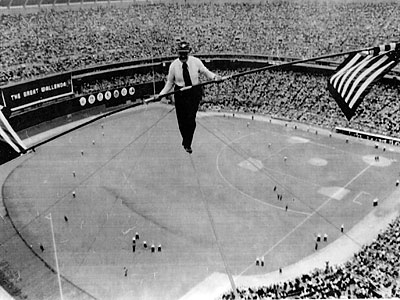
There is a fine line between doing something great, and being crazy.



 Coach Gallion Perspective