High School Baseball Thoughts
We hear a lot of talk, both positive and negative, about high school baseball in the St. Louis/Midwest region. For the Gamers, our perspective on high school baseball is simple:
- Our players play high school baseball from March-May
- Most high school baseball coaches and programs are trying to do a good job
- We have a responsibility to support our players and do whatever we can to support their high school programs & coaches.
In short, we want our players to succeed in high school baseball. And, we want to have positive relationships with high school coaches.
The reality is that, in many high schools in the region, baseball is secondary sport (to football, basketball and in St. Louis even soccer). Every high school program is different and has both negatives and positives. That is true in all sports.
- High school baseball is a complement to summer baseball, not a substitute. Summer/Fall baseball is the biggest exposure opportunity and most challenging competition for college bound players.
- You need to work hard during the Winter to be ready to succeed in high school baseball beginning March 1st.
- Offseason high school workouts are a complement to your Gamers winter workouts, not a substitute. We have clear evidence and experience that players get significantly better during the Gamers Winter program. The same is not true for many offseason workouts at high school programs.
- You need to take advantage of the practice and rep time available during high school baseball. It is your choice on whether or not to use that time to get better. Make the right choice.
- Similarly, each player has the choice of being a leader or a follower in their high school program. We encourage our players to play and practice like Gamers, even in their high school program. This style of play requires courage and leadership if it is not the “culture” of your high school program.
- You need to take responsibility for staying healthy during the high school baseball season — especially pitchers. Do not pitch past your pitch count limit. Make sure that you are properly warmed up and ready to pitch before taking the mound. If you are not throwing enough during team practices, take care of it during your own time. TAKE RESPONSIBILITY FOR YOU OWN ARM HEALTH.
In short, we advise our Gamers players to take personal accountability and responsibility for their time in high school baseball — for all aspects of their game.
In our experience, for most players, their high school baseball results (batting average, Wins/losses, etc…) has little bearing on how they perform in 15-17u summer baseball. And, frankly high school baseball has minimal bearing on college baseball opportunities. High school baseball is not a target of college baseball recruiting in the Midwest.
- Players that dominated during high school baseball, but struggled during summer baseball and failed to win the attention of college recruiters.
- Players that were not even in the starting lineup in high school as juniors, but then went on to have great summers and land D1 college roster spots before the senior year.
Local Tournaments – Summer 2011
The list below includes the St. Louis area tournaments that our teams will be playing in this summer.
Gamers As Mutli-Sport Athletes
This is a mis-perception that the Gamers programs forces players to focus only on baseball and that we do not allow multi-sport athletes. This is simply not true.
- To play baseball at an elite level requires year-round training (or at least 9 months). This is true for other sports too. If a player elects to play two sports, he is not going to have much free time. Slacking off on academics is not a choice. So, multi-sport student athletes must sacrifice other things — like hanging out with friends, playing video games, Facebook, part-time jobs, etc… That is just reality.
- Playing another sport cannot become an excuse for not practicing and training for baseball. We have dozens of players in our program that play multiple sports at a high level AND hold down a 3.0-4.0+ GPA. They find a way to still get their offseason baseball work in around winter sport commitments and school. It is possible to be a successful multi-sport student athlete. But, it takes a lot of self-discipline and sacrifice to make this happen.
- During the summer baseball season, we allow for one flex weekend for our high school age players that can be used to attend a sports camp (or a family commitment). However, other than the flex weekend, we expect that baseball will clearly be the number 1 sports priority from March-July. This becomes an issue when football showcase camps and AAU basketball tournaments are scheduled in the summer.
- During the Fall before and after a player’s Junior season, we strongly encourage him to play Fall Baseball. There are a lot of good exposure opportunities during the Fall for this age group. If a player plays 6 weekends during each Fall, that is 12 weekends of additional exposure opportunities that he will get during his”recruiting” year. This is very difficult for football and soccer players. But, it is a tradeoff if the player he wants to play college baseball.
- Finally, we strongly encourage Fall baseball as a way for all players to get more reps and more playing experience. The Spring Seasons in St. Louis are too cold and wet. Some of the best weather for baseball is in August-October. It is possible to get in an additional 30 games, 7 pitching starts and 80-100 at bats per year by playing Fall baseball. This helps St. Louis kids stay more competitive with kids from the mid-South (TN, NC, SC, OK, AR) where the Spring seasons start a lot earlier.
The Gamers program is non-profit
There is some miscommunication floating around regarding the Gamers program that needs clarified …
- Coach teams (for professional coaches at 15u and above)
- Provide instruction and training
- Provide administrative support (maintain rosters, register for tournaments, etc….)
"Burnout"
A common criticism of club sports programs (baseball, hockey, soccer, volleyball, etc…) is that kids get “burned out”. This can be a legitimate concern for players, parents and coaches. It is sad to everyone when a player no longer enjoys a sport.
- The player simply had too many competing priorities on his plate. There is a limit to what a teenager can do. The combination of 1-2 sports plus high level academics is pretty close to the limit. When you start adding music, choir, boy scouts, church groups, college applications, ACT tests, school clubs, a 2nd or 3rd sport, girls, part-time jobs, etc.. , it gets out of control very fast. All of those things are good and worthy activities. But, there is only so much time available. It is impossible for a teenager to be successful in 10 different things. It may superficially look good on a college application. But, we all know that truly successful people set priorities and focus their attention on the things that are most important to them.
- Instead of being truly “burned out”, the player has decided that he no longer wants to advance to college level baseball, so the hard work is no longer worth it. Sometimes there is a disconnect between where a player can play college baseball and where he wants to go to college. Of course, you never know until you try — so I am always suspicious about this (there are hundreds of great colleges to choose from across the country). This may be a rational decision — but it is NOT burnout. This looks a lot more like quitting to me. Quitting when things get difficult can become a hard habit to break.
- The parents — not the player — were burned out from the schedule, travel and cost of club sports. This is 10x more likely than player burnout since the parents do not experience the joy of working hard, being part of a team and playing the game. So, we need to be very careful to separate player burnout from parent burnout. Parent burnout is a more common issue.
- The burnout was not truly the result of the sport — but was the result of a pressure packed player-parent relationship that surrounds the sport. Dads (and Moms) that push too hard for their son’s success can create a situation where he finally pushes back. Club sports tend to attract driven parents. This parental pressure, on top of the normal competitive pressure of club sports, can be too much for a teenager. Players can get burned out from the double decker pressure that surrounds his sport.
- Teach young athletes to prioritize their activities, to make sure they are selecting activities that are most important to them. If baseball drops off the list, then that is OK. But, that is not burnout — it is called setting priorities and is an important part of growing up. If baseball can help teach that lesson, then it has played a significant role in a young man’s development.
- Help young men through the decision process on college baseball, so they can make rational decisions and decide early on whether or not they want to push for that goal. A young man is better off making that determination at 15, instead of working hard to do everything right, but then quitting at 17.
- Deal with parent burnout. Find ways to make it easier for parents to be part of a club sports by relieving schedule and travel requirements. Program organization, communication and advanced scheduling help alleviate parent burnout.
- Teach parents to be supportive and active, but not to ADD to the pressure of club sports. The Positive Coaching Alliance offers a good online course on this called “Second Goal Parent” (it is worth the $30). This transition is very challenging to a lot of parents. But, it makes a big difference in a players’ perception of the game. And, makes it more likely for a young man to continue to love the game.
Do You Learn More from Winning, or Losing?
Everyone wants to win. It’s fun and it makes you feel good. But, if you win all the time, say >80% of your games, it that a good thing?
If your goal is to collect trophies, then winning tournaments every weekend is the way to do it. The easiest way to achieve this goal is to play in tournaments against weaker competition.
But, winning all the time can be a dangerous. Talented players learn that they do not need to give full effort and focus to win. Bad habits and ugly baseball emerge. If you have an especially talented group, you can win 80+% of your games, and your players could actually regress during the season.
You can learn a lot from winning. But, if winning is too easy, the lessons are negative.
If your primary goal is to develop players and help them reach their potential, then winning is a secondary priority. The way to achieve this goal is to play only against the top competition each weekend, or to “play up” against older players. Against better competition, every game matters and there are no easy games where you can consistently win despite bad habits or poor style of play.
But, you still need to be competitive against the top competition. If you win 30% of your games, but every game is competitive, players can get a lot better. If you get blown out, then the players get discouraged and lose their passion for the game. Losing is not fun. If you lose too much, that can also create the opportunity for bad habits to emerge.
So, do you learn more from winning or from losing? In my opinion, you learn the most when you do both — win 40-60% of your games. In you win 80% of your games, you need to play against better competition to develop your players. If you win 30% of your games, then your players will get discouraged.
In 2010, our high school teams won 67% of games. Our middle school teams won 68% of games. In 2011, we are looking to ratchet our schedules up a notch, especially at 15u and 16u (it would be hard for our 17u’s to play a more challenging schedule without flying South every weekend).
Start of Gamers Winter Workouts
Next Saturday (Dec. 4th), we officially start our 4th year of winter workouts in the Gamers program. We are continually tweaking details of the program, to make the training more effective and to make it better and better every year. So, there are a few changes in store for this winter.
- The baseball skills and fundamentals taught are based on what is successful at the highest level of baseball.
- All age groups, from 12u to 18u, are taught the same skills and fundamentals.
- The 3 1/2 hours on Saturday and 2 1/2 hour rep sessions are quick paced, intense workouts.
- The coaching and instruction is the best available, and there is a lot of it. Four Gamers directors (Whiteside, Cooper, Pregon and Gallion) and 3 lead instructors (Beckmann, Wheeler, Rosen) lead Saturday practices. This is in addition to 4 team coaches at each age group.
- Performance training is built into the program, because you must first be a good athlete before you can become a good baseball player.
- The Gamers life lesson program is weaved throughout the 12 weeks of winter workouts.
- Attend every session on Saturdays and rep sessions. If they need to miss a time slot, they make it up by attending another time slot on Saturdays or another team’s rep session.
- Show up properly hydrated and fueled, with a healthy snack to eat on Saturdays before the Hammerbodies session.
- Listen and apply instruction, even if it feels uncomfortable at first.
- Work hard and stay focused, even if a coach is not watching.
- Are engaged and energetic during the workout — we love high energy players who want to get better.
- Show up on time, with the proper workout uniform and looking like a Gamer.
90th Percentile Rule
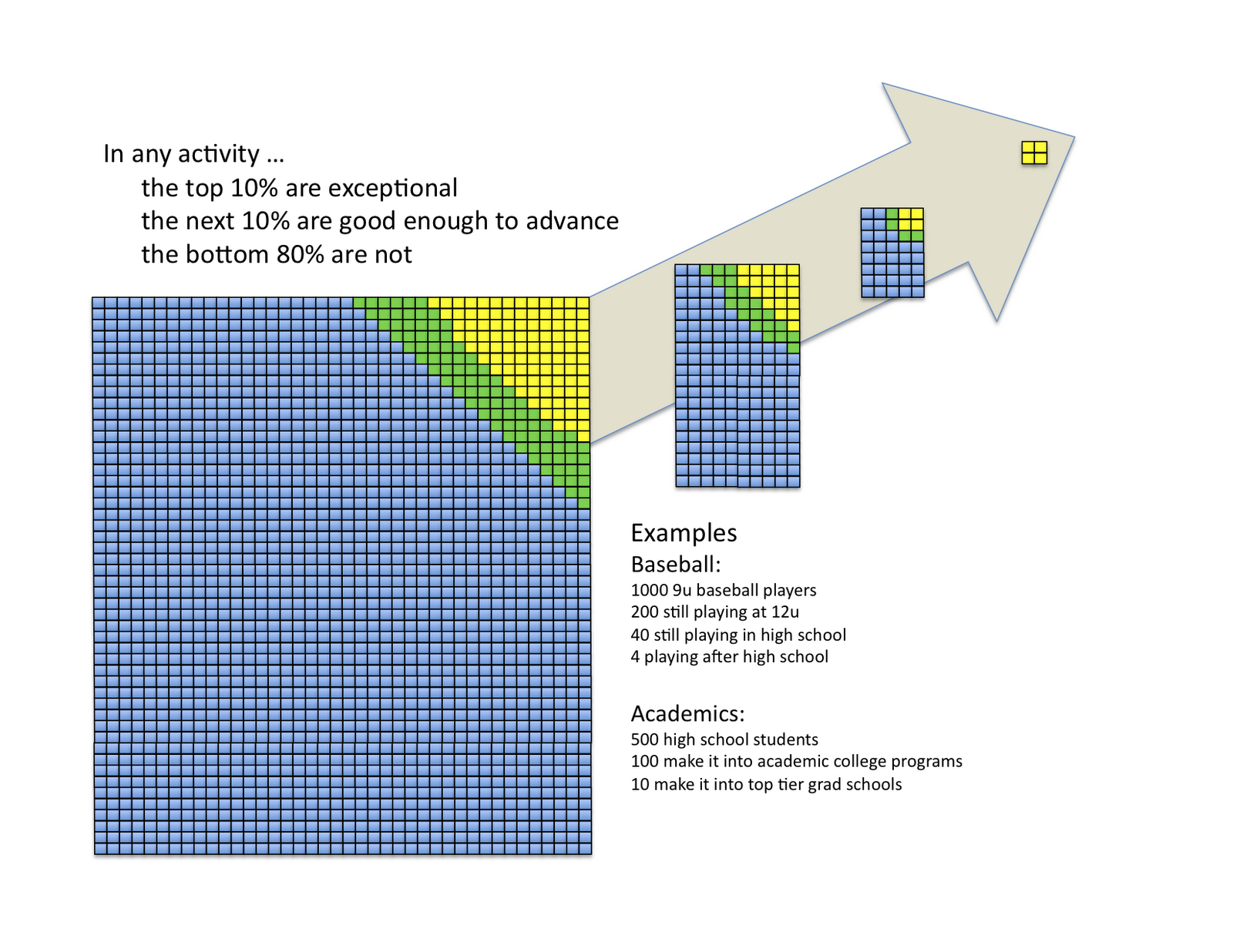
Is the Gamers Program too "hard"
Sometimes I hear comments or get impressions from some parents or players that the Gamers program is “too hard” — that the expectations are too high, the time commitment too much, or the requirements too demanding. The statements sound something like this:
“_____ just wants to have fun playing baseball, the Gamers practice too much”
There is a lot commonality in all these statements.
First, the word “just” comes up time after time. This can sometimes be an honest word. For example, when a player has made a tradeoff between a lower priority thing (baseball) and a higher priority thing (another sport?), and baseball is “just” not that important to him any more.
Or, sometimes “just” can be a very dangerous word that establishes artificial limits on effort and commitment, like “Little Johnny just doesn’t want to work that hard”.
Very few people in life are successful by “just” doing something. Success requires extraordinary effort, commitment and passion. The word “just” does not fit with success.The other commonality in the statements above is the seemingly opposite relationship between “fun” and “hard work”. This is also very dangerous.
The dialogue above is why the Gamers program is structured the way that it is. Our program was well thought out, not a random collection of ideas and buzzwords. It was never meant to be “just” baseball. It was never meant for players that have “fun” being mediocre.
Over the years, we have made some adjustments and changes to the program and will continue to do so. And, we make some mistakes, like all passionate, hard working people do.
A youth sports program that has the courage to follow and teach these principles can have a profound impact on young men, on the field and off.
But, it takes courage and conviction to follow these principle — anything else is “just” a compromise.
Path to college baseball
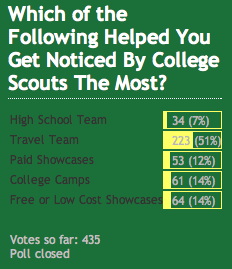
Rounding Third (http://roundthird.blogspot.com/) conducted the following survey of D1 college bound players last year. This is a nationwide survey and includes states like Florida, Texas and Georgia where high school baseball is a little higher level than here in Missouri/Illinois.
 Coach Gallion Perspective