Mom was right … again
So, my mom always told me (and still does) that if you don’t have something nice to say, don’t say anything. Proven right again. A couple days ago I made a unkind joke about a baseball facility in an email that went out internally to just 60 Gamers players/families. Like they say — never put anything in an email that you wouldn’t want printed in the Wall St. Journal. Sure enough, the email got forwarded outside the Gamer group — resulting in an embarrassing situation. Not my intent. But. Mom was right.. again.
Chalk that one up to my growing list of mistakes. But, if you are not making mistakes, you are not trying hard enough.
And sometimes, you really do need to say things that are not nice. Not in an email like my recent stupid mistake. But, as a coach, a business person, a friend, negative things sometimes need to be said especially if there is a chance that it will have a positive impact. This is a real dilemma for coaches and teachers. We need to say a lot of things that are not nice. Players need you to coach them. You cannot help them unless you say things to make them better. If you stay silent and overlook things, you are simply cheating the player that wants to be coached. That is my opinion.
If a player wants to be coached, I (we) are going to coach him. That means being honest, demanding and holding him to high standards. If he wants to be coddled and told only what he wants to hear, then I am not the right coach and the Gamers is not going to be the right program. This is the topic for a whole other blog post. But, in this narrow case — of coaching — Mom is not entirely right. Sometimes, “not nice” things need to be said. Sometimes, you need to actually care.
Reality vs. Myth
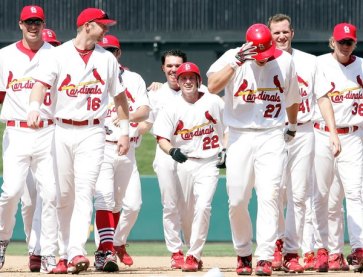
So, I overhead a conversation between a couple of HS seniors this weekend about how the HS school teams were stacking up this year. In talking about one of the teams that has been good in recent years, one player said “They lost Player A and Player B, so they will not be as good”. The other player agreed. A and B were well known baseball names, and had been since they were 12 years old.
But, the reality was that there was a Player C on that same team that out-performed Player A and B for the past 2 years. But, Player C was a late bloomer and did not have the “myth” aura surrounding him. He was just really, really good and very competitive and physically a late bloomer. So, he led the team in offensive production and no one noticed. Not his peers, not the Post Dispatch, not college coaches. I am not sure even his high school coaches noticed (or cared).
How does this happen?
Well, this happens A LOT in baseball, and is increasingly a problem with the early college recruiting cycle. A lot of “prospect” rankings are based on the “myth”. Everyone just talks to everyone else and sooner or later the myth emerges. Observed data that supports the myth is amplified, all non-supporting data is ignored. Meanwhile, Player C works his tail off and gets better and better and no one notices. College coaches get sucked into this all the time — especially at top notch colleges who love to recruit the “name” players. They fall for hype and let myth distort reality.
Here is reality:
Dominance in 12-14u baseball has little meaning
Velocity does not equal outs.
Bat speed is useless unless a hitter squares up live pitching consistently with real bats (not toy bats) and can hit an off speed pitch.
High velo throws over 1B or cutoff man’s head result in losses.
Foot speed has no value unless you get on base and take good angles.
Physical size has nothing to do with heart, competitiveness or mental toughness.
All the potential in the world means nothing unless you can perform, during games, against other players.
The problem with baseball is that you need to observe LOTS of data to make a real conclusion, or have a very, very well trained eye. Without lots of data, all you have is myth.
It’s the way the human mind works. We latch onto data that supports existing beliefs while ignoring other data. You remember the 400′ bomb, but forget the 8 chased curve balls in the dirt. You remember the 92 on the gun, but forget the 50% strikes that ruined the game. That’s how myths are fed. That is why scouting is so hard and draft/recruiting results so inconsistent.
My problem is that I love Player C kids. They are fun to coach, fun to watch and have more long-term upside because they have learned to work hard and overcome adversity. But, it takes a lot of mental toughness, personal courage and passion to fight through being in the shadows while the spotlight is searching for the myths. Too many Player C’s get disappointed and give up their passion before their body catches up to their skill and hard work.
If I was a college coach, I would just recruit late-bloomer Player C kids and not chase myths.
“Overuse” over-hype
Over the past month, about a dozen different people have forwarded to me an article from the Cleveland Plain Dealer featuring Dr. James Andrews, the renowned surgeon. He has been in the news a lot lately with all the TJ surgeries in MLB last Spring. Besides his famous patient list, he has done great work in trying to understand the cause and prevention of elbow and shoulder injuries in youth pitchers. Here is a copy of the Cleveland article.
From the start of the Gamers program in 2007, we have been at the leading edge of applying “healthy” pitching discipline in our program. We implement all the preventive elements that the ASMI (Dr. Andrews’ research institute) recommends based on the medical research — specifically:
- Healthy throwing mechanics (this is #1 cause of injury according to Dr. Mathews — no inverted W’s)
- Age-based pitch count limits and rest between pitching appearances (unfortunately we cannot control April/May HS pitching)
- No one in our program pitches more than 8 months competitively — March – October
- Focus on overall athleticism and strength, not just sport-specific movements (like throwing)
- Throwers 10 program
So, we have been strong proponents of Dr. Andrews and ASMI guidelines. We are not perfect, but we try really hard.
Given the above, it is important to note that a number of Dr. Andrews comments in the Cleveland article are unfair and not supported by any research or any study that has been published by ASMI. If you are interested in the actual medical research, I have collected it in one place. Click here for the batch.
Here are the comments that I find unfair — they are highlighted in yellow in the article:
“Now parents are hiring ex-pro baseball players as hitting and pitching instructors when their kid is 12 … they’re ending up getting the kids hurt” I have never seen any research or debate about hitting year round — or baserunning, or fielding. So why is he talking about hitting?
Second, he later goes on to say that “bad mechanics” is the #1 contributor to pitching injuries. You cannot have it both ways — you cannot say that a kid needs proper mechanics to prevent injury and then turn around and blame parents for taking their kids to instructors.
“The almighty dollar has a lot to do with it, yes. Some parents are putting a football or baseball in their kids’ hands when they’re 3 years old, and it’s not just for a fun little photograph…. What’s happening is, the tail is wagging the dog.” This comment reminds me of the former MLB player/commentators criticizing travel baseball, while at the same time marveling at Bryce Harper, Mike Trout and all the young pitchers throwing 98.
Maybe, just maybe, the kids actually enjoy playing baseball and want to play as much as possible and at the highest level possible. My data indicates that this is 6.5x more likely than a parent or travel coach forcing kids to play (being facetious about the stat. not the point).
The bigger point though is that Dr. Andrews’ comment above has nothing to do with medical research or technical expertise. It is an opinion based on limited interaction with players/parents in pre-op and post-op rooms. The tail is not wagging the dog in most cases.
“I said in the book, I want parents and coaches to realize the implications of putting a 12 or 13 year-old through the type of athletic work done by a 25 year-old. Parents and coaches, though they mean well, need to understand what the long-term effects of overuse can be.” I have never seen a youth baseball workout or practice that even comes close to the athletic demands of a Division 1 college program. The Gamers program has a very challenging and disciplined practice and workout routine — probably more so than other youth programs. But, everything we do is age appropriate. It is nowhere close to what a 20 year old, Division 1 college baseball player does.
I understand that the medical research on this topic is lacking, so it leaves room for lots of opinions like the above.
But, these broad generalizations about select travel baseball are unfair and getting over-hyped. Things have gone too far when you have position players citing “over-use” as an excuse for poor performance at the plate or pitchers worried that 50 innings over 4 months is “over-use”. We do not need another “syndrome” or “condition” for young people/parents to use a crutch. Especially, young people who are trying to work hard and pursue something they love at a high level. Their efforts should be cheered, not discouraged as “over-use”.
What we do need is parent/coach education. A 30 minute video class for baseball coaches, similar to what the Positive Coaching Alliance does, would go a long way. Call it ASMI coach certification. I would require every coach in the Gamers program to go through certification. That would be a productive step — more than taking pot-shots at parents and coaches. Coaches and parents want to do the right thing. The baseball/surgery industry needs to arm them with the right education. Right now, there is nothing out there. Google “baseball pitcher arm health” . Not much there . A good education resource would go a long way!!
Freshman Grades Count!!!!
This is now the 7th year I have published this post for Freshman Gamers.
========================================================
This post is for all 15u (2018 Gamers — current high school freshmen). Parents, please make sure that your son reads this. This is a friendly reminder from the Gamers program that care about you and your success.
Grades matter. If you want to play college baseball, grades matter A LOT. Time after time, we see that GPA’s and test scores make the the difference in the college recruiting process.
Now that you are a freshman, your grades now count toward your high school GPA. Three years from now, you will be filling out college applications. Every application will ask for your GPA and a copy of your high school transcript.
In baseball, your skill level and athleticism as a Freshman don’t matter a much as your skill & athleticism as a Junior.
GPA’s are different — they are cumulative. Sometimes, freshman do not realize this simple fact — your grades as a freshman count JUST AS MUCH as your grades as a junior or senior.
Here is an example for you.
Say a player gets the following GPA’s:
Freshman – 3.6
Soph – 3.2
Junior – 3.6
Senior – 3.2
The result of this would be an overall GPA of 3.4. Pretty good (our 15u-17u Gamers have an an average GPA of 3.6).
But, say that same player got a 2.2 GPA his freshman year instead of a 3.6. (ALL C’s and a couple B’s)
Do you what he would have to achieve during his sophomore, junior and senior years to graduate with the same 3.4 GPA?
To overcome this bad start, he would have to achieve a 3.8 GPA for all three years to pull his overall GPA up to a 3.4 by the end of his senior year.
So, his grades would need to look like this:
Freshman – 2.2
Soph – 3.7
Junior – 3.8
Senior – 3.9
Which scenario looks easier to you?
Don’t put yourself in the situation of playing catch up. It is hard to do. Plus, freshman classes are a lot easier than junior and senior classes. It gets harder and harder every year to play catch up.
So, the point of this email is simple — Get off to a good start with grades during your freshman year.
What are the common excuses that we hear about why players “mess up” during their freshman years?:
– They don’t hand in homework or “projects” (the easiest points to get).
– They procrastinate, waiting until the last minute for assignments and studying
– They have bad study habits (do not use their time efficiently)
– They spend more time on Facebook, Twitter, Instagram…. than on schoolwork
– The are not serious in the classroom, preferring to be the class clown or just doze off
Essentially, they do not take school seriously and don’t put their best effort forward. That is not consistent with being a Gamer.
It is now mid-October. You are well into your first semester of high school. If you are doing well, congratulations and keep up the good work!!
If you are not doing well so far, fix the problem RIGHT NOW. Talk to guidance counselors, teachers and your parents. Get a tutor. Fix the problem before it gets too late to impact first semester grades. Your grades are not going to change unless you change something. It is your responsibility.
Remember, these grades count and will be with you for the next 3 years.
If the Gamers coaches or directors can help, let us know. We see a lot of young men go through this process and know what works. That is why I am sending out this email.
Getting off to a good start is one of the most important success factors in high school. It is like throwing a first pitch strike.
Good luck,
Coach Gallion
Entitlement in Select Sports
Select level sports require significant investment on the part of parents and players.
First, there is all the financial investment — for games, practices, instruction, training, uniforms, equipment, travel, etc… It adds up to a big number in baseball, and an even bigger number in hockey and other sports (try figure skating or gymnastics!!!).
Second, it is a tremendous time investment on the part of the player and the parents. Practices, games, working out, travel, fundraising, etc.. It takes so much time. For passionate players, this is fun and they enjoy it. But, there is no question that the time commitment pushes other activities down the list of priorities. This is an investment.
What’s the payoff from all this investment in time and money?
1. The opportunity to learn how to succeed — the value of character, hard work, discipline, teamwork, focus, etc.. that select level sports provides an incredible platform to teach.
2. The opportunity to pursue a passion at the highest level that you are capable of, which creates self-satisfaction, happiness and is a whole lot of fun.
3. The opportunity to build deep relationships with teammates and coaches that share your passions. Relationships matter.
The most important payoffs are qualitative. Select sports can make you a better person. If you want to convert it to numbers, in select HS baseball you also get the opportunity to get 30-60% of your college paid, worth about $80-100k.
So, the equation is simple — you put in the investment in money and time, and then just collect the payoff of the 3 points above plus $100,000 in college costs. It’s that simple right? Unfortunately, not even close.
Investment of money and time/effort does not “entitle” the player or parents to anything except the opportunity. There are no guarantees you will get the results above. That’s just real life.
There is no entitlement to success in sports.
There are no guarantees that:
If you spend money on training, you will be an above average player in games
If you train and eat like an Olympic athlete, you will succeed on the field
If you attend every practice, you can throw strikes on the mound or hit strikes at the plate
You can do everything right, and fail in the short-term. No one is entitled to success. Sometimes, it is really, really hard and takes a lot longer than patience allows. My personal belief is that hard work and perseverance will eventually create success. If not, David Eckstein would not have won 2 World Series rings.
But, feelings of entitlement derail this journey. If players/parents feel entitled to success, then they lose patience when things get tough. No one goes through youth baseball without some tough months. But, if you feel entitled to succeed, you start looking for excuses and blaming others when you experience failure. Perspective is lost. You look for the easy way out, when in reality there is not one.
No one is entitled to success. Sometimes you just fail, even if you do everything right. Maybe that is the single most important lesson that select sports can teach. It’s about the journey, not the destination.
Personal Record – 101 Games, 102 practices
2014 baseball season ended for me last night. Bitter sweet. Managed to break my personal record for number of games coached this year: 30 with 14u in April/May, 49 with 15u summer and 32 with 16u Fall — 101 total. Got to 99 last year, and to exactly 100 in 2005 and 2006. 101 probably will end up being personal best.
Way eclipsed the total practice time this year though … 102 total team practices (non-game days). 20 more than prior years, thanks to double duty with 14u during the Winter program.
Very rewarding to work with so many fine young men over the course of 10 months. I am honored to coach them and keep learning stuff all the time.
Pirate Fest and Mutiny
It is Pirate Fest in Ft. Myers Beach this weekend during the Perfect Game WWBA Underclass National Championship, just like is has been for the past 8 years. Full Pirate gear and a Pirate Ship. During the simulated battle, a couple scrawny Pirates (right out of Pirates of the Caribbean), yelled out “mutiny“. As this played out on the Boulevard, I reflected on the following:

“Daddy-Ball”, huh?
When we started the Gamers program in 2007, my youngest son was 16 years old and a charter member of the Gamers. The “established” team program in the area wrote a scathing post in STLTODAY’s sports forum (anonymously of course), calling the Gamers “daddy-ball”. It was the first time I had heard that term, but I knew it probably was not a good thing. It has bothered me since because the term was clearly directed at me, not Dave, Scott or Matt.
Now it has been 7 seasons since my son was a Gamer and I have been coaching as a non-dad. I am a much better baseball coach now than I was then. And, the Gamers now have paid coaches up and down the organization, and exclusively from 14 up.
It takes a really special person to be a good dad coach. I was terrible at it. But, these exceptional people are around. We have had some incredibly good dad coaches in our program over the years, who run their teams like Gamers teams and graduate great players at 15u into in the Gamers HS program. These coaches do an excellent job and go above and beyond in achieving the goals of the Gamers program. I have tremendous respect for these guys and the Gamers program has been built on their efforts. With these guys, it is nowhere close to “daddy-ball”.
But, unfortunately, they are the exception.
So, what is “d-ball”?
It is coaching baseball with the primary mission/goals focused on the coach not around the players. “D-ball” coaches are not necessarily bad people, they are just coaching for the wrong reasons.
No one admits to being a “d-ball” coach. But, it is easy to spot using some telltale signs:
How They Act and Talk:
A lot of emphasis on recruiting and behind the scenes deals to get early puberty and physically developed players surrounding the coaches’ son(s) — they pretty much know every kid’s name on every team in the age group and treat them like chess pieces.
On the phone a whole lot with parents. More time talking to parents, than talking to the players
Lot’s of opinions on other players, based on limited observation data and limited experience in talent evaluation (BTW — college coaches would NEVER listen to a dad coach)
Smug sales pitch focused on their “selling point”– telling people what they want to hear, like “all the best players, etc..”. If it sounds too good to be true …
Big focus on results, little focus on process of playing baseball
Big focus on now, little focus on 3 years from now
Drama … in the dugout, on the field, and in the stands.
Small rosters and pick-up players to maximize that “last roster spot” (i.e. players as chess pieces — if the roster is full, it’s hard to play chess)
How They Practice and Play
Systematic favoritism – OK with some parents as long as their son is on favorites list. But, eventually players hurt on both sides of this equation.
Poor practice organization, because everything is done from the dad’s perspective. Lots of standing around in lines for ground balls and cage time, with limited instruction or development of core skills — like arm strength, footwork or bat speed. But, the dad coach is busy all practice.
Results based instruction — fielding a groundball with bad technique is rewarded, booting a groundball with proper technique is criticized.
Batting orders and positional lineups built around the favorites
No focus on athletic training and nutrition as the players get older. This really hurts players as they progress to 13 and 14u.
Pouting and negative body language after mistakes are made. Drama on the field, in the dugout and in the stands.
Little true energy put into playing the game right. Just lots of words with no enforcement, especially if son is culprit. I have never seen a d-ball team where the pitcher backs up bases — almost always in the middle of the field pouting after a double.
The scoreboard matters more than how the team plays.
When discussing a loss, immediately jump to BLAME — always one particular play from one particular player — ignoring the other 20 outs in the game. It’s always “that one play” . Reality of course is that is NEVER that one play in baseball.
That’s how you spot a “d-ball” team. Sadly, we have had a few in our program as the years have passed. It never works out.
Some “d-ball” teams can be very talented and win lots of games and trophies if the coach is a good recruiter and has a good sales pitch. Heck, some club programs have become the umbrellas organizations for “d-ball” teams. It is easy to sell jerseys, rent cage time and just outsource coaching to “d-ball” coaches with their own agendas. It’s easy for the club and works well for the “d-ball” coach looking out for his own interest.
But, the “d-ball” process eventually ends the same way …. other players catch up physically, the sales pitch wears thin and parents/players get a clue and start looking out for their longer term self interest. At this point, the players unfortunately have to jump off onto a steep learning curve on how to play the game right. Sometimes, there is nowhere to jump to.
Why do parents put their sons in these situations? I am not sure, but my guess is that:
- It feels good temporarily — everyone is looking for easy success (note — in baseball it does not exist for 99% of players)
- The sales pitch tells them what they want to hear, and they do not see through it
- They are on on the positive side of favoritism (at least temporarily)
- Some parents enjoy the drama, politics and water cooler talk. So, it’s a good fit for the parents.
- They do not truly understand the alternative model, which is more work, harder, imposes discipline and is challenging
“Burnout” is overused term
A common criticism of club sports programs (baseball, hockey, soccer, volleyball, etc…) is that kids get “burned out”. This can be a legitimate concern for players, parents and coaches. It is sad to everyone when a player no longer enjoys a sport. But, the term “burnout” is being used way too frequently these days; making this topic is worth discussing
Over the past decade, I have been around hundreds of young men that have played A LOT of baseball. And, I honestly cannot recall a single pure case of true “burnout” — where a player had passion for baseball, but then lost that passion because he played TOO MUCH baseball. That just does not happen.
Instead, all of the cases where a player/parent used the term “burnout” were one of three situations:
- The player simply had too many competing priorities on his plate. There is a limit to what a teenager can do. The combination of 1-2 sports plus high level academics is pretty close to the limit. When you start adding music, choir, boy scouts, church groups, college applications, ACT tests, school clubs, a 2nd or 3rd sport, girls, part-time jobs, etc.. , it gets out of control very fast. All of those things are good and worthy activities. But, there is only so much time available. It is impossible for a teenager to be successful in 10 different things. It may superficially look good on a college application. But, we all know that truly successful people set priorities and focus their attention on the things that are most important to them. If elite sports is not the short list of priorities, then that’s a rational decision — but it is not burnout.
- Instead of being truly “burned out”, the player has decided that he no longer wants to advance to college level baseball, so the hard work is no longer worth it. Sometimes there is a disconnect between where a player can play college baseball and where he wants to go to college. Again, this may be a rational decision — but it is NOT burnout.
- The parents — not the player — get burned out from the schedule, travel and cost of club sports. This is 10x more likely than player burnout since the parents do not experience the joy of working hard, being part of a team and playing the game. So, we need to be very careful to separate player burnout from parent burnout. Parent burnout is real and is a lot more common issue.
So, the secrets to dealing with situations above are:
- Teach young athletes to prioritize their activities, to make sure they are selecting activities that are most important to them. If baseball drops off the list, then that is OK. But, that is not burnout — it is called setting priorities and is an important part of growing up. If baseball can help teach that lesson, then it has played a significant role in a young man’s development.
- Help young men through the decision process on college baseball, so they can make rational decisions and decide early on whether or not they want to push for that goal. Also, it is important to be realistic about college selection and let college fit guide the process. A successful college experience is a lot more important than just playing college baseball.
- Deal with parent burnout. Find ways to make it easier for parents to be part of a club sports by relieving schedule and travel requirements. Program organization, communication and advanced scheduling help alleviate parent burnout.
In addition to the situations above, there is more a natural form of frustration and personal anxiety that comes with high level sports. Everyone feels this way sometimes, and it feels like you are “burned out”. Face it, no one enjoys doing box jumps or 2 sets of 50 pick-ups. And, no one enjoys an 0-15 slump at the plate, or walking the winning run. Sometimes the combination of hard work and the frustration of failure feels overwhelming. These are “sticking points”.
When players reach this point of frustration, it is easy to quit and claim “burnout”. But, to truly excel at something requires that you get to this sticking point and push through it. Repeatedly.
A short break to re-energize can help (the offseason).
But, 9 times out of 10, players love their sport, love to play it and love working hard to get better. Sometimes a player just needs a little support and mentoring to help push through sticking points.
Being Exceptional
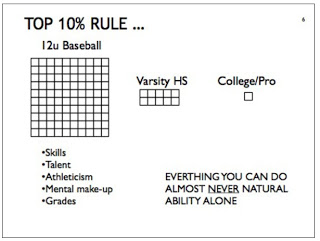
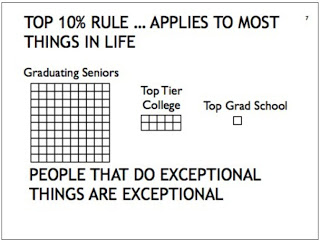
For the past 5 years, I have shown this graphic to our high school age baseball players:
 Coach Gallion Perspective