Derek Jeter — Greatest Cutoff/Relay Play
After just teaching the sure double tandem relay system, I was reminded of this play by Derek Jeter. So, winning run on 1st base, sure double down the right field line. Most MLB teams have the 2B go out as the lead guy and the 1B go out as the tandem guy on balls down the line. This is how the Yankees do it. The RF overthows BOTH guys! Jeter sees it happening and sprints out of nowhere to back up the bad throw and flip the ball to Posada at home to nail Jeremy Giambi, whose failure to slide probably costs the A’s a trip to the World Series.
That was not part of our lesson. That is being an athlete and “in the moment”.

Win 3 Innings, Win the Game

That 3rd inning it really hard to win!
"It’s all about the money"
As a co-founder of the Gamers baseball program, I get offended when I hear people say, or post comments saying, that youth baseball programs are “all about the money”.
I understand the premise. Baseball was once a low cost sport. It no longer is. When you start adding more games, more exposure events, more coaching, more practice and more travel to the equation, it becomes an expensive sport. So, a sport that used to cost $800 per year to play now costs $2000-$3000.
But, that is NOT “all about the money” It is about what you GET for the money.
I am pretty qualified to understand the budgets and economics of youth baseball. We started the Gamers program with this challenge => how much baseball development could we squeeze into $2000-$3000 per year per player. That was the going cost in other programs that we benchmarked and other sports like hockey and soccer.
We have managed to squeeze a lot of baseball into the budget. It includes:
– A maxed out schedule of games/tournaments
– An intensive winter training program
– Lots of indoor facility practice time during peak hours
– Lots of outdoor practice time
– Professional coaching — the best in the area
– Top tier instructors, that work directly with the players during winter AND summer
– Series of seminars, clinics, instructional materials, etc…
Our program makes no money. We are a non-profit. We have no shareholders that collect profits. I am the Managing Director, and take ZERO compensation for administering the program or coaching. All of the money is spent on playing or practicing baseball. We collect money from parents, and then directly spend it on all the things above.
I have a basic principle … no one in a youth baseball team program should make a dime from a kid unless they are directly interacting with him.
So, with the Gamers it’s about what you GET for the money!
Unfortunately, the above is not true for many other programs.
There are some folks in the baseball community that are A LOT more focused on making money than developing players. I am not talking about the people who actually coach, teach, instruct or work with directly kids. I am talking about the people who skim money off the top without directly adding value to individual players.
They are behind the scenes, treating baseball like a monopoly game or fantasy baseball and creating a dark cloud over youth baseball. They would rather recruit players than develop players and sell snake oil to parents by telling them what they want to hear.
Unfortunately, in too many of these cases, it IS about the money.
Here are some warning signs to look for to determine whether or not money from a baseball program is being skimmed into someone’s pocket instead of being spent on baseball:
- Does every person getting paid have active involvement with every player and/or team in the program? If not, what are they doing instead?
- No straight answer on how much the program actually costs or what is included, with lots of fine print about fundraising.
- With us, everything is at http://stlgamers.squarespace.com/storage/Frequently%20Asked%20Questions.pdf
- Fewer tournaments/games, with schedules that come out late and constantly shift.
- 11-14u, we play 12-13 tournaments in April-July. Schedule is done by Feb.
- For HS, we play EVERY weekend from Memorial Day to August (8-10). Schedule is done by December.
- At high school ages, we practice/play 1-2 weeks longer each summer than other programs.
- Team rosters that are large and regularly shift around.
- Our roster sizes are capped at age of players, 15u teams have 15 players, 16u teams have 16 players, etc… and rosters rarely change during the season
- Non-peak times for indoor training
- Gamers teams train at peak times on Saturdays and on weeknights during the busy indoor training season. And, we practice at the top baseball facility in the region.
- Baseball training requirements that are “in addition to” the program fees — like extra winter hitting or pitching programs that you are required to do, but costs an additional $800.
- All required baseball training in the Gamers is included in the program fees. You can do other stuff, like private lessons, etc.. but it is optional
- Low quality, inconsistent or “outsourced” instruction.
- Gamers baseball instruction for every kid (11-18u) is provided by Matt Whiteside, Scott Cooper, Dave Pregon, Nick Beckmann, Justin Rosen and Kevin Wheeler. Every kid. Nothing is outsourced to temporary instructors.
- Making money on uniform sales
- We get a small rebate from J Mac’s that is plowed directly back as a credit for uniform purchases the following year. No money from jersey or uniform sales is skimmed off the top. No special patches or emblems.
- Skimping on coaching expenses by using fewer paid coaches (1 per team instead of 2) and more Dad coaches at HS ages
- We have 2 professional, paid coaches at each HS age team. This costs A LOT. But our players deserve it. We have no unpaid dad coaches at HS levels.
- About 1/2 of our younger teams are also professionally coached
- Playing in high school age tournaments that are run by affiliated companies or where the program gets a kickback or commission.
- We run 2-3 Gamers tournaments per year. Cost is $675 for 5 games, ALL games on the D1 college fields. We make no money running these tournaments.
- Other HS age tournaments cost $850-$1500 per event. The difference is profit to the tournament operator. Most independent tournament operators do a great job and work hard to earn every penny of this.
- If program teams only play in affiliated tournaments, this is a red flag.
- Making money on player/parent travel expenses. This is done by not allowing players and parents to share rooms and/or increasing nightly rates at low-end hotels to cover a booking commission that it provided back to the program, i.e. you pay $95 for a $85 hotel room, with $10 going back to the baseball program as a commission.
- Note: Gamers program does not do either. We stay at name brand hotels as required by our tournament operators, do not mark-up rates. We do not make a dime from travel expenses.
Ask what you are getting for your money and where the money actually goes. If a program director cannot or will not answer the questions honestly, don’t get sucked into to empty promises.
What We Want in Tournaments
Each year, the Gamers host 3-4 invitational tournaments for 17u teams at locations like Mizzou, Arkansas State, Memphis University, SLU and Lindenwood. These are elite tournaments, usually just 6 teams with every game played at the college field and attended by a significant number of college coaches.
Running tournaments in select level youth baseball is a challenging business in its own right, and is not a good fit with our overall program mission. Sure, we could make some money doing it. But, our mission is not about making money. Instead, we strive to work with tournament operators across the country to help us achieve our goals.
- Good competition
- Good fields, worthy of the hard work that our players put into playing
- Well-organized events, planned in advance and with good and timely communication
- A commitment to playing games and overcoming weather problems (this means investment in field crews and turface)
- Space to hold our pre-game practices/warm-ups
- Reasonable time limits, where you play to 7 innings 80% of the time
- Good umpires, appropriate for the level of competition, that want to be there
At the national level, Perfect Game and USA Baseball deliver events that meet these requirements. Regionally, Pastime Tournaments is doing a good job. Locally, Greater Midwest Baseball is working hard to deliver good events. There are others in the mix too.
We look forward to the day when our families spend a lot less money on travel.
Updated — HS Baseball for Freshman and Sophomores
Note — this is a updated post from last year. Topic is still important.
This posting is primarily directed to 15u and 16u Gamers.
WE HAVE HAD KIDS COMMIT TO PLAYING COLLEGE BASEBALL WITHOUT EVER STARTING A GAME IN VARSITY HIGH BASEBALL.
There are lots of reasons why this happens. I am not going to dwell on that. But, it happens.
Good luck and we cannot wait until summer baseball kicks off.
What makes a Good "Team Program"??
Probably not a big surprise that the development of baseball “team programs” in the Midwest region has moved a little slower than in the Southeast and Texas. But, things are now moving fast and furious in the region — due to three factors:
- No one — parents, players, coaches — wants to be “left out” when the music stops
- Reality => Relax … there will always be good teams for good players to play on and for good coaches to coach. Focus on finding the right fit.
- Instructors/coaches think it is an opportunity to make money without working
- Reality => Sorry, that might sound good but it is called stealing and it is not sustainable.
- It looks easy to start. Just recruit a couple of big, fast kids per age group and you have “a program”.
- Reality => Easy to start, very hard to sustain over 2-3 years.
- First, it should feel more like a school or academy than a business. If it acts like a business, then money will trump instruction and baseball every time. BTW, the easiest way to make money in a baseball program is to divert money from coaching, instruction, practice facilities, uniforms, tournaments, vans and hotels into your own pocket. Some people are very creative at this.
- Other than some admin support, no one in the team program should put a dime in their pocket unless they instruct or coach. No freeloaders or figureheads getting a cut of the action. The leaders of the program need to be passionate about coaching baseball and actually know the kids.
- The teams need to practice at least as much as they play. 50 games @ 2 hours = 100 hours of game time. So, they need to practice 100 hours too. Even at the high school ages. And, coaches/instructors need to be at the practice. Practice time needs to be organized, managed and challenging. If not, the players will not develop. There is a place for “all-star” teams that do not practice (Aflac Games, Area Code, etc..). But, these are individual programs, not team programs.
- The program leaders needs to focus on developing young men. It is not just about baseball. If a kid dedicates 100 hours playing games and 100 hours practicing, he needs to learn more than just how to field a ground ball. Baseball is a great platform to teach young men how to succeed in life. If coaches are not capable of or inclined to deliver those messages, the baseball experience will have little impact on the players’ lives and a great opportunity is wasted.
- It can’t just be about the name on the front of the jersey. “Brand-name” teams are not the same as a team program. The program needs to “add value” to the teams and players, meaning:
- Better instruction/coaching and mentoring
- Better facilities
- Better organization, planning and scheduling
- Better competition, better exposure, etc…
- The program needs to be well organized and well managed, with a lot of communication to players & parents. Rosters, coach assignments, game schedules, practice schedules, etc.. should be communicated months in advance. A “unorganized program” is an oxymoron — but it is too often the case.
- And, finally, it starts and ends with Quality People. Are the coaches and leaders of the program good role models? Are they good teachers? Are their priorities and values consistent with yours?
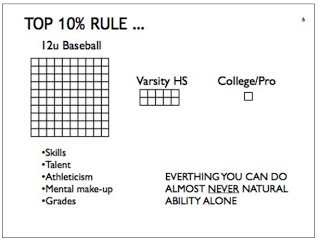
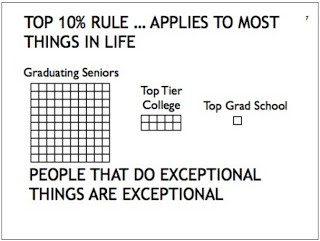
Teaching Young Men to be the 1%
For the past 2 years, I have shown this graphic to our high school age baseball players:
Developing Pitchers
Below is an article about developing players from the Baseball Excellence Newsletter. It is in complete alignment with the Gamers philosophy.
|

Little Things Matter
I once worked closely with a famous CEO, Chuck Knight from Emerson Electric (he retired about 10 years ago). Although Chuck was responsible for a huge global company, he had a unique and extreme ability (borderline obsession) to focus on “little things”. If there was a slight flaw in your logic, or numbers on a spreadsheet did not add up, he would latch onto it and use it to challenge your thought process and your core belief is what you were recommending.
He had no tolerance for illogical thought, and even less for lack of passion.
To Chuck, little things mattered because they indicated the quality of your thought process and your level of passion.
During one presentation at Emerson, I casually “rounded off” operating profit margins from 16.1% to 16%. A rookie mistake. Chuck called me on it, saying “we sell our grandchildren for a .1% around here son”. Still not sure if he was joking …
So, I learned that little things matter. Little things add up to big things. The long-term is just a series of short-terms. Your success right now dictates your long-term success (unless you plan on winning the lottery).
With that mindset, it is hard to be lazy and let things “slide by”. Pursuing excellence requires a focus and dedication to little things that matter.
Let’s apply this to teenage baseball players. You have all heard coaches say “do the little things right” – from baseball coaches, basketball coaches, football coaches. It is a great compliment for a baseball player if a coach says that “he does the little things right”. Success in baseball comes to people who do the little things right, whether that is blocking a ball in the dirt, throwing strike 1, hitting the cutoff man or taking the extra base.
All those little things add up to success. That is what pursuing excellence is all about. Paying attention, and excelling in all things – big and small.
Here are some more baseball examples of little things what will determine your success: the 3 check points of the wall drill on EVERY swing, proper head position on EVERY throw, perfect footwork on EVERY groundball, 4 seam grip on EVERY throw, etc…
In the Gamers program, we spend a lot of time working on these “little things”. Our program practices are scripted out to the minute. We are trying to teach you to pay attention to little things, to be aware of them, and to care about them.
What about little things like wearing your uniform and hat right, tucking in your shirt, having a nice clean haircut, and looking and carrying yourself like a baseball player? Little things like that say A LOT about you as a player, your team and your program. That’s why we care about them. Little things matter.
It’s true in school too – do you frequently miss easy questions on tests? You knew the answer, you understand the concept – but you just make a stupid little mistake and missed a question. If you received B+ or C+ on your report card, I can almost guarantee you that, if you had done more of the little things right, you could have raised your grade to an A or a B. A couple of missed questions on a test or a late or forgotten homework assignment are the difference between a B+ and A.
Little things matter – they make the difference. But, to recognize and take action on the little things, we need to be aware of them. We need to be aware of and observe the little things. And, we need to care about them.
Little things separate winners from losers – in baseball and in life.
 Coach Gallion Perspective