Playing vs. Older Teams
Once good baseball players get to be 8th grade and beyond, they get the opportunity to play against older kids a lot more often. Our 14u Gamers have played a number of 15u teams already this Spring and recently came off a game vs. a very good 16u team in Des Moines. This can be an intimidating experience. But, it is very important to the process of learning to play baseball.
Size, strength and athleticism are important in baseball — but it is only part of the game. Skills, execution and mental toughness are just as important. When younger players play older players that are more athletic, they need to rely on the other elements of the game to compete. Throwing strikes, hitting cutoff men, controlling the running game, Quality at Bats, etc.. are still the secret to winning. It is all the little things that matter even more in these situations. It is how David beat Goliath.
As these opportunities becomes more frequent, good players rise to the challenge and start enjoying the process of competing against players that are older and more athletic. Slowly, players realize that the age and size of competition does not determine success. What determines success is performing to the best of your ability, regardless of the situation. If you achieve this, the competition does not determine your success — YOU DO.
That is a great spot to be in, competing against yourself.

It is Courage That Counts
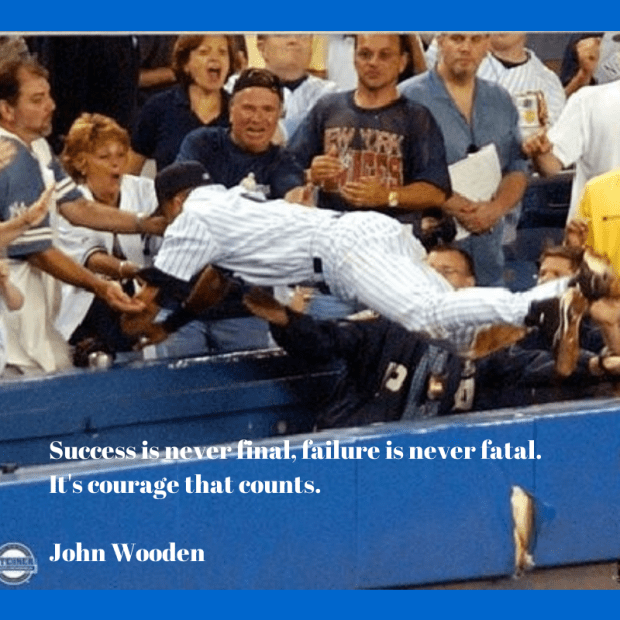
Success is never final, failure is never fatal. It’s courage that counts.
John Wooden
14u in PG25 Central
Other than a few issues regarding competitive courage and Playing Big, I am very proud of the 14u Gamers this weekend. Becoming baseball players is a PROCESS. And, we made a step forward this weekend. We had a CF with a huge chunk of flesh out of his leg ready to start the next game but was trapped by urgent care, we had a RHP dominate a very good 15u team, we had three other great pitching performances, we played catcher like studs and had a 3B and SS make every play with guts.
Also we ran 34 poles.
Here is the other side…. Through 4 innings, the cumulative score of our games was 5-2. The final score after 7 innings was 17-2. What happened in innings 5, 6 and 7? We can compete against good 15u teams if we play 7 innings!
Two issues — courage and confidence.
Answer is to Play Big. It is really that easy. Not mechanics, not strategy, not anything but allowing yourself to Play Big.
Perfect Game Super 25 – Central Region
Gamers first PG25 event this weekend in Des Moines, Iowa. Perfect Game could not get enough 14u teams in the Central region to participate (literally hundreds of 14u teams chose not to participate), so the 14u Gamers played up at 15u — which was great for us but would have been a disaster for most 14u Central Region teams.
Pluses
Des Moines is a great city. Would have been a great college baseball exposure town if Drake actually had a baseball team.
Great to play against 15u Iowa and Wisconsin teams that were pretty darn good.
Good Fields
Solid umpires except for an egregious homer call at 3rd when we were pressing the favored Iowa team that the local ump proudly knew by their first name. Other than that, umpires were good.
Cons
Bad marketing — a PG25 regional with a 14u berth to Ft. Myers but 2 14u teams — in Perfect Game’s home state of Iowa. I think I would have been paying teams to play if I was PG to rescue the situation. Embarrassing to me personally who built this up as a big event for the Gamers 14u squad … lesson learned on that one.
Bad organization — sold as a 4 game minimum tournament, but no 15u team wanted to stick around for a consolation game (because they considered the event no big deal???, the Gamers have never turned down a Perfect Game consolation game unless it meant missing a school day or a flight from FL). So, I had 13 families stick around for 3 1/2 hours in the parking lot of Simpson College after our 3rd game only to to be told that the consolation game would be versus a 17u team in another 2 1/2 hours at 5pm — which would put us home at 1am. Four game minimum with no actual plans to make it one. That was quite embarrassing to me.
When I make players/parents travel to compete, I do not expect to be embarrassed. This is not a very high expectation.
So, net-net, left with 13 14u players/parents totally unimpressed with Perfect Game that I am now trying to convince to spend a fortune to go to East Cobb and to Ft. Myers. Not very smart business — for me, or for Perfect Game. Especially, when the competing program in our region is selling the Premier Tournaments are better than Perfect Game.
Winning the 0.5 seconds each play
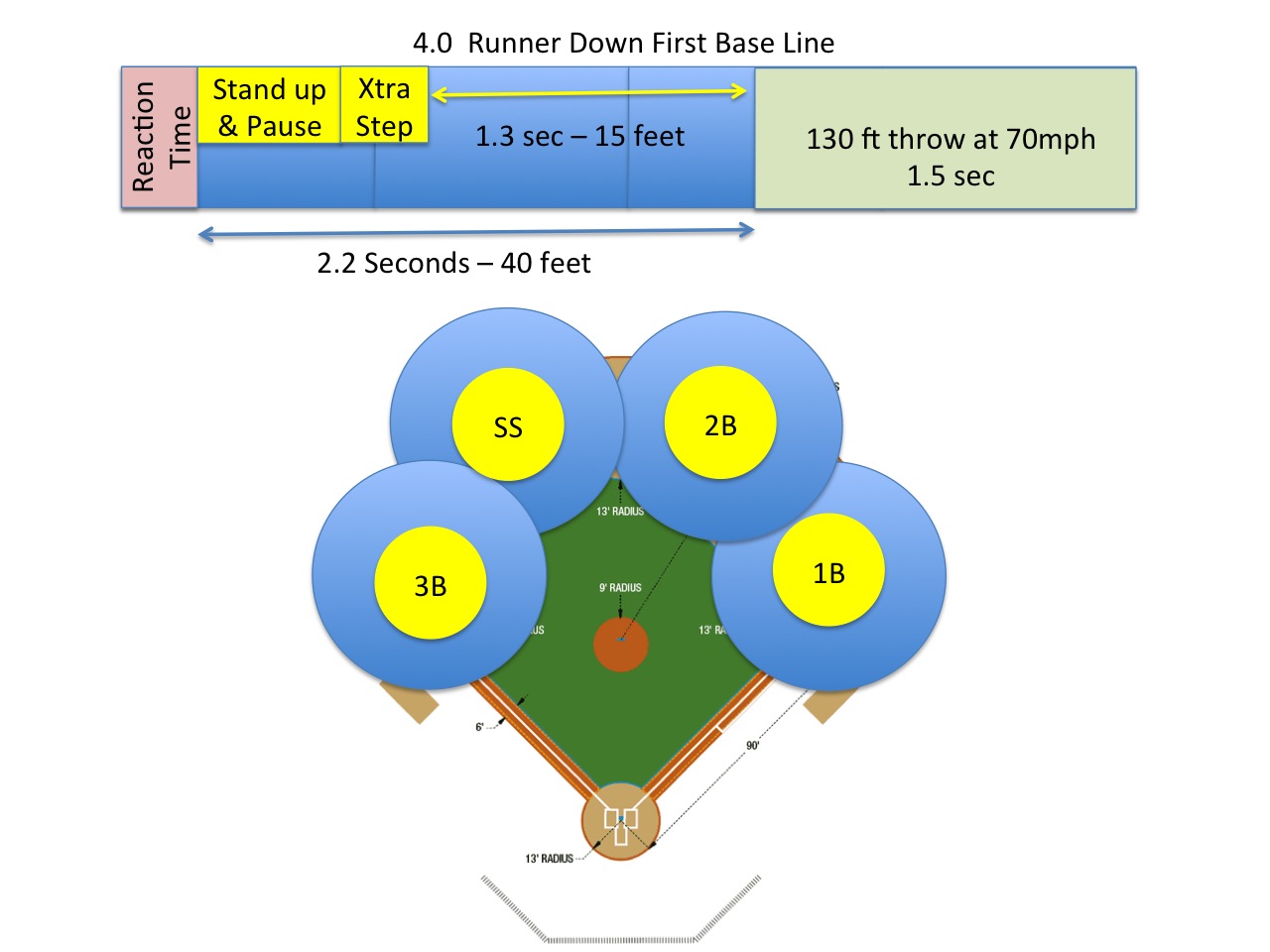
Baseball action happens in 4 second intervals. This is the time it takes for an athlete to run 90 feet — so it is a fundamental design element of the game since it was created.
A groundball to the infielders must be fielded, thrown and caught in 4.0 seconds — which is the time it takes the runner to get down the line.
A well hit ball in the air to the outfield will travel in the air about 4 seconds, longer if it is high pop-up. An outfielder has 2 x 4.0 seconds to throw a guy out going from 1st to third — 4 seconds to catch the ball and 4 seconds to throw it 220 feet to a tag out.
So, where does that 4.0 seconds go? Well, it takes an athlete at least 0.3 seconds the visually see, process information and fire muscles. So, that leaves just 3.7 seconds to make the play.
Watch a young fielder and this is what you see … After the initial 0.3 sec reaction time, the fielder takes an additional 0.5 seconds before reacting because he either was not really ready to react OR he is unsure of himself and wants to see the ball more before reacting. When he does this, he usually straightens up and visually pauses. So, that is 0.5 seconds of lost time.
Then fundamentals come in to play — as an infielder, he will be inefficient to the ball, taking 1-2 extra steps and giving up time. As an outfielder, he will drift to the ball, instead of running full speed to a spot to make the catch. So, time and fielding range is reduced proportionally.
The impact of the lost time is significant. The charts below show the relationship between lost time and fielding range. This is a battle over time. There is at least 0.5 seconds in play between doing it right and doing it wrong. The challenge is to win that 0.5 seconds. To do that:
– You need to be ready to react, immediately. This means that as the ball enters the hitting zone, your muscles are ready to fire explosively, like a sprinter.
– You need to anticipate the ball off the bat, reading bat angle, and ball angle even BEFORE contact. Really advanced fielders do this. Repetitions are the way to learn this.
– You need to trust yourself. Your first instinct will be right 95% of the time, don’t waste 0.5 seconds trying to be right 100% of the time. It is not worth it.
– You need to be smart — pitch count, what pitch is coming, hitter tendencies, etc.. all of that information can make you really good at “guessing”
– Relax and breathe… in pressure, tense game situations, your breathing becomes shallow and your muscles tense up. Tense muscles with low oxygen cannot react.
Win the 0.5 seconds and your range and fielding success will go up immediately.

Guy in the Glass — Gamer Required Reading List
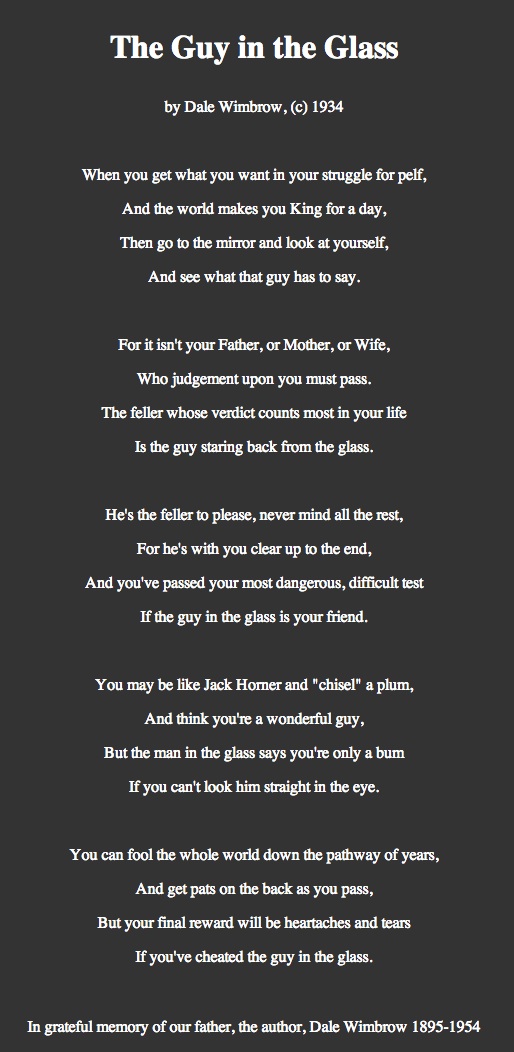
pelf (pɛlf). n. 1. money or wealth, esp if dishonestly acquired

The Impact of Big Innings
Here is a typical box score from a youth baseball game:
1 2 3 4 5 6 7 Total
Team A 0 0 6 0 3 1 0 10
Team B 4 0 1 1 0 0 0 6
Team A had 2 BIG INNINGS (3 or more runs). Team B only had 1 BIG INNING, then the offense went to sleep. The whole game was determined by one inning (top 3rd). This is the BIG INNING.
That is the story of youth baseball — it is almost always that “one” inning.
Playing the game right means that you create BIG INNINGS on offense, and avoid BIG INNINGS on defense.
In 2007, I coached a very talented 15u team. Here is their win/loss record in “BIG INNING” Games:
We got a BIG INNING – 35-5 (+23)
They other team got a BIG INNING – 6-18 (-12)
There were no BIG INNINGS by either team 15-13 (+2)
So, how to you win youth baseball games? You create BIG INNINGS on offense and eliminate them on defense. Pretty simple.
BIG INNINGS in youth baseball are usually the result of the defensive team “giving up” extra outs through errors on routine plays or because of walks. It is hard to create a BIG INNING on offense without a little help from the opposing team.
Here is how to produce BIG INNINGS on offense:
- Be willing to take a walk – see lots of pitches
- The more pitches you see, the more likely a BIG INNING will happen. The pitcher will eventually start to groove the ball. When the pitcher grooves the ball, be AGGRESSIVE.
- Force errors by running out EVERY groundball. Put pressure on the defense, even on routine plays. Hustle puts pressure on fielders.
- Do not give up outs on the basepaths. This is called “running yourself out of a BIG INNING“. Outs are precious, save them.
- Battle for every at bat. Do not give away at bats. A lot of BIG INNINGS are the result of what happens after 2 outs. Every Quality At-Bat above 3 in an inning will result in another run.
Lets turn the tables now — here is how to prevent BIG INNINGS on defense:
- Throw strikes and get ahead of hitters
- Minimize walks, minimize pitches. This keep the fielders focused and ready to make a play.
- Make routine plays. Do not compound errors by making bad throws or missing cutoffs.
- It is usually the second error or second walk of the inning that creates a BIG INNING. When an error is made, the entire team needs to pick the intensity and focus up another notch. The first error in an inning usually OK, the second error hurts bad, and the third error enables the BIG INNING. Walks have the same impact.
- Prevent runners from taking the extra base by executing cutoffs and relays correctly and eliminating passed balls/wild pitches. Maintain force out and double play situations.
- Always get an out in a sacrifice, force out or squeeze situation.
- Take control of the game. Call timeout. Get a cheap out on a back pick. Have and infield meeting. CHANGE THE MOMENTUM!!! Don’t just sit back and watch it happen.
- Refocus with 2 outs. Get your team off the field.
If you are able to prevent BIG INNINGS, your team will compete in every game.
Favorite Story from Coach by Michael Lewis
I had a flashback on this passage from the book Coach this evening as a pitcher struggled in the first inning.
What happened next is that, during Mardi Gras break, I left New Orleans with my parents for a week of vacation. I had thought that if I was a baseball success — and I was becoming one — that was enough. But it wasn’t; success, to Fitz, was a process. Life as he led it and expected us to lead it had less to do with trophies than with sacrifice in the name of some larger purpose: baseball. By missing a full week of practices over Mardi Gras, I had just violated some sacred but unwritten rule. Now I was back on the mound, a hunk of Ben-Gay drooping from the brim of my cap, struggling to relocate myself and my curveball. I didn’t have the nerve to throw the spitter. I’d walked the first two batters I faced and was pitching nervously to the third.
Ball 2.
As I pitched I had an uneasy sensation — on bad days I can still feel it, like a bum knee — of having strayed from the Fitz Way. But I had no evidence of Fitz’s displeasure; he hadn’t said anything about the missed practices. Then his voice boomed out of our dugout.
”Where was Michael Lewis during Mardi Gras?”
I did my best not to look over, but out of the corner of my eye I could see him. He was pacing the dugout. I threw another pitch.
Ball 3.
‘Everyone else was at practice. But where was Michael Lewis?”
I was now pitching with one eye on the catcher’s mitt and the other on our dugout.
Ball 4.
The bases were now loaded. Another guy in need of a shave came to the plate.
”I’ll tell you where Michael Lewis was: skiing!”
Skiing, in 1976, for a 15-year-old New Orleanian, counted as an exotic activity. Being exposed as a vacation skier on a New Orleans baseball field in 1976 was as alarming as being accused of wearing silk underpants in a maximum-security prison. Then and there, on the crabgrass of Slidell, La., Coach Fitz packed into a word what he usually required an entire speech to say: privilege corrupts. It enabled you to do what money could buy instead of what duty demanded. You were always skiing. As a skier, you developed a conviction, buttressed by your parents’ money, that life was meant to be easy. That when difficulty arose, you could just hire someone to deal with it. That nothing mattered so much that you should suffer for it.
But now, suddenly, something did matter so much that I should suffer for it: baseball. Or, more exactly, Fitz! The man was pouring his heart and soul into me and demanding in return only that I pour myself into the game. He’d earned the right to holler at me whatever he wanted to holler. I got set to throw another pitch in the general direction of the strike zone.
”Can someone please tell me why Michael Lewis thinks it’s O.K. to leave town and go . . . and go . . . and go? . . . ”
Please, don’t say skiing, I recall thinking as the ball left my hand. Or, if you must say skiing, don’t shout it. Just then, the batter hit a sharp one-hopper back to the mound. I raised my glove to start the face-saving double play at the plate, but with my ears straining to catch Fitz’s every word. And then, abruptly, his shouting stopped.
When I regained consciousness, I was on my back, blinking up at a hazy, not terribly remorseful Fitz. The baseball had broken my nose in five places. Oddly enough, I did not feel wronged. I felt, in an entirely new way, cared for. On the way to the hospital to get my nose fixed, I told my mother that the next time the family went skiing — or anyplace else, for that matter — they’d be going without me. After the doctor pieced my nose back together, he told me that if I still wanted to play baseball, I had to do it behind a mask. Grim as it all sounds, I don’t believe I had ever been happier in my adolescent life. The rest of that season, when I walked out to the pitcher’s mound, I resembled a rounder hobbit with a bird cage on his face; but I’d never been so filled with a sense of purpose. Immediately, I had a new taste for staying after baseball practice, for extra work. I became, in truth, something of a zealot, and it didn’t take long to figure out how much better my life could be if I applied this new zeal acquired on a baseball field to the rest of it. It was as if this baseball coach had reached inside me, found a rusty switch marked Turn On Before Attempting to Use and flipped it.
Friday night
10pm Friday night, I am scouting a 14 year old baseball team that we play tomorrow. Not complaining.

 Coach Gallion Perspective